

Introduction
When people picture cutting-edge computing, they usually imagine sleek laptops, cloud data centers, or AI chips humming in a server farm. Rarely do they picture the mainframe — yet this decades-old technology still processes the vast majority of the world’s most critical transactions. Every time you swipe a credit card, withdraw cash from an ATM, book an airline ticket, or receive a paycheck, there’s a good chance a mainframe is quietly working behind the scenes. Far from being a relic of the past, the mainframe remains one of the most powerful, secure, and reliable computing platforms in existence — and in 2026, it’s more relevant than ever as enterprises fold AI directly into their core systems.
What Is a Mainframe?
A mainframe is a large, high-performance computer system designed to process enormous volumes of data and transactions simultaneously, with exceptional reliability, security, and scalability. Unlike typical servers, mainframes are engineered for continuous, uninterrupted operation — often running for years without downtime — and they support thousands of concurrent users and applications on a single system.
Mainframes are typically used by large organizations: banks, insurance companies, airlines, government agencies, healthcare providers, and retailers — any business where massive-scale, mission-critical data processing simply cannot fail.
A Brief History
- 1950s–60s: The mainframe era began with machines like the UNIVAC and IBM’s early System/360, introduced in 1964. The System/360 was revolutionary because it introduced a single, compatible family of computers that could scale up or down without forcing customers to rewrite software — a principle still honored in IBM’s mainframes today.
- 1970s–80s: Mainframes became the standard for corporate and government computing, handling payroll, banking, and airline reservation systems.
- 1990s: The rise of personal computers and client-server architecture led many to predict the “death of the mainframe.” It didn’t happen — instead, mainframes evolved to integrate with distributed systems.
- 2000s–2010s: IBM’s zSeries (now IBM Z) modernized the platform with Linux support, virtualization, and open standards, allowing mainframes to run alongside cloud and web technologies.
- 2020s: Mainframes embraced hybrid cloud, containers (via Linux and Kubernetes), and quantum-safe cryptography.
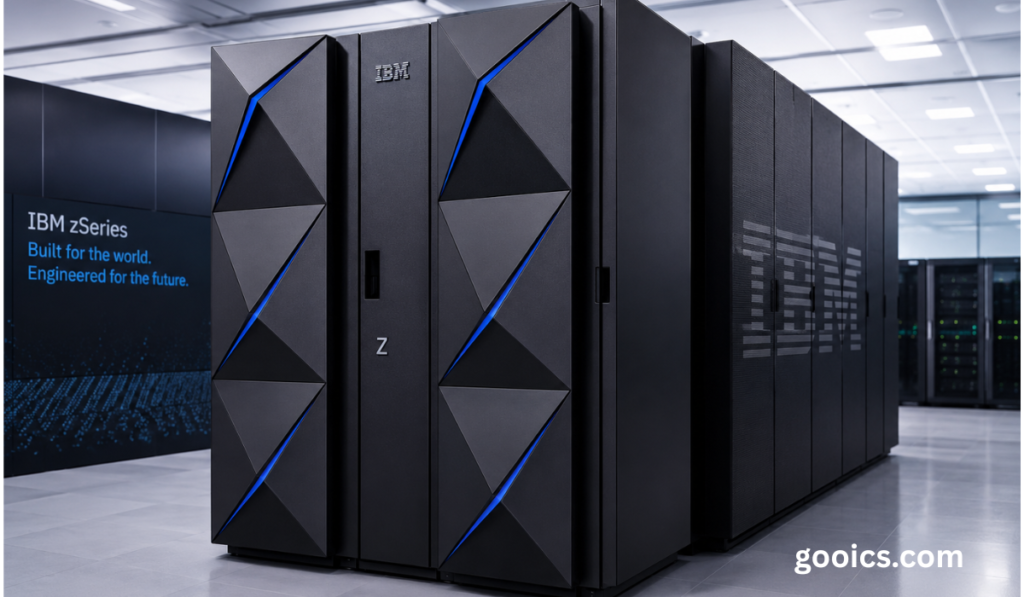
- 2026: IBM’s z17 platform, built on the Telum II processor, has become IBM’s best-selling mainframe generation in 20 years, with compact rack-mounted configurations and embedded AI acceleration via the new Spyre co-processor. Enterprises are increasingly using mainframes to run AI inference directly against sensitive data, avoiding the latency, cost, and governance headaches of shipping data to the public cloud.
Key Characteristics of Mainframes
1. Massive Transaction Processing Power Mainframes are built to process billions of transactions per day. A single IBM Z system can handle tens of thousands of transactions per second without breaking a sweat — a scale most distributed cloud architectures struggle to match cost-effectively.
2. Near-Perfect Reliability Mainframes are designed for “five nines” (99.999%) uptime or better. Redundant components, hot-swappable hardware, and self-healing capabilities mean planned downtime is rare and unplanned downtime is rarer still.
3. Unmatched Security Mainframes feature hardware-level encryption, pervasive data protection, and tamper-resistant architecture. Modern systems like the z17 include quantum-safe cryptographic capabilities, anticipating a future where quantum computers could threaten today’s encryption standards.
4. Vertical and Horizontal Scalability A mainframe can scale to support enormous workloads on a single physical system (vertical scaling), while also integrating with distributed, cloud-native environments (horizontal scaling) through APIs, containers, and hybrid cloud tooling.
5. Backward Compatibility Code written decades ago — often in COBOL — can still run on modern mainframes. This is both a strength (protecting enormous investments in legacy systems) and a challenge (a shrinking pool of COBOL-literate engineers).
Mainframes vs. Cloud and Distributed Systems
A common misconception is that mainframes and cloud computing are competitors. In reality, most large enterprises use both, and increasingly, mainframes function as a foundational hybrid cloud component rather than an isolated island. Key differences:
| Factor | Mainframe | Cloud/Distributed Systems |
|---|---|---|
| Best for | High-volume, mission-critical transactions | Flexible, elastic, general-purpose workloads |
| Reliability | Extremely high (built-in redundancy) | High, but dependent on architecture |
| Cost model | High upfront/licensing cost, low per-transaction cost at scale | Pay-as-you-go, can scale costs unpredictably |
| Security | Hardware-level, deeply integrated | Strong, but shared responsibility model |
| Legacy compatibility | Excellent (decades of code still runs) | Often requires re-architecting |
Recent industry analysis has found that some organizations achieve significant total cost of ownership reductions — in some cases greater than 60% — by consolidating distributed workloads onto mainframe platforms, particularly for GPU-adjacent AI workloads that benefit from co-locating compute, memory, and storage in a single rack.
Who Still Uses Mainframes?
Mainframes remain deeply embedded in industries where failure is not an option:
- Banking and finance: Core banking systems, payment processing, and fraud detection
- Insurance: Policy management and claims processing
- Airlines: Reservation and ticketing systems
- Government: Tax processing, social services, and defense systems
- Retail: Large-scale inventory and point-of-sale systems
- Healthcare: Patient records and claims systems requiring strict compliance
Mainframes continue to underpin more than half of revenue-generating workloads at a majority of large enterprises, particularly in heavily regulated industries where auditability, uptime guarantees, and data sovereignty carry real financial and legal weight.
The AI-on-the-Mainframe Shift
One of the most significant recent developments is the integration of artificial intelligence directly into mainframe architecture. Rather than exporting sensitive data to external AI clusters or public cloud environments, organizations can now run AI inference — fraud detection, risk scoring, real-time decisioning — directly where the data already lives.
IBM’s z17 platform, powered by the Telum II processor and paired with the new Spyre accelerator chip, is designed specifically for this purpose. This approach reduces latency, simplifies regulatory compliance, and avoids the cost and risk of moving enormous volumes of sensitive financial or healthcare data across networks. Analysts have also noted that AI-assisted tools are now being used to help modernize and maintain decades-old COBOL codebases — though industry research cautions that wholesale “mainframe exit” projects, where organizations try to rewrite core systems entirely with generative AI, fail more often than they succeed.
Common Myths About Mainframes
Myth: Mainframes are outdated technology. Reality: Mainframes are continuously modernized, now running Linux, Kubernetes, open-source tools, and AI workloads alongside their traditional transaction-processing roles.
Myth: Mainframes are too expensive to justify. Reality: While upfront costs are significant, the per-transaction cost at true enterprise scale is often lower than equivalent distributed infrastructure — especially once licensing, staffing, and downtime risk are factored in.
Myth: Nobody uses mainframes anymore. Reality: Mainframes still process the majority of global financial transactions, and demand has grown alongside enterprise AI adoption, even as some analysts note short-term sales volatility tied to major product refresh cycles.
Myth: Mainframe skills are irrelevant today. Reality: With a large share of experienced mainframe professionals nearing retirement, organizations and universities are actively investing in mainframe education and modernization tooling to address a looming skills gap.
The Future of Mainframes
Far from fading away, mainframes are being reimagined as a core piece of hybrid cloud and AI infrastructure. Key trends shaping their future include:
- AI-native architecture — embedding machine learning inference directly into mainframe hardware
- Quantum-safe security — preparing for a future where quantum computers could break today’s encryption
- Hybrid cloud integration — mainframes acting as one node in a broader, cloud-connected enterprise architecture
- Modernized developer tooling — bringing DevOps practices, APIs, and AI-assisted coding to legacy COBOL and PL/I environments
- Sustainability — consolidating workloads onto fewer, more power-efficient systems as data center space and energy costs rise
Conclusion
The mainframe is not a relic — it’s a workhorse that has quietly evolved alongside every major shift in computing, from the rise of the internet to the current wave of enterprise AI. For organizations that cannot afford downtime, data breaches, or compliance failures, mainframes remain the gold standard of computing reliability. As AI, hybrid cloud, and quantum-safe security reshape the technology landscape, the mainframe isn’t just surviving — it’s adapting to stay at the center of the world’s most important digital infrastructure.
Here’s an FAQ section on Mainframe:
1. What is a mainframe computer?
A mainframe is a large-scale, high-performance computer system built to process massive volumes of data and transactions with extreme reliability, security, and scalability. It’s used by organizations that can’t afford downtime — banks, airlines, insurers, and governments.
2. Are mainframes still used today?
Yes. Mainframes still process the majority of the world’s core financial transactions. In 2026, demand has actually grown as enterprises adopt IBM’s z17 platform to run AI workloads directly on secure, on-premises hardware.
3. What’s the difference between a mainframe and a regular server?
A mainframe is engineered for continuous uptime, massive concurrent transaction processing, and hardware-level security — capabilities that go well beyond what a typical server or distributed cluster offers. Mainframes also maintain strong backward compatibility, letting decades-old applications keep running on modern hardware.
4. Is a mainframe the same as the cloud?
No, but they’re not competitors either. Most large enterprises run mainframes and cloud infrastructure together in a hybrid model — mainframes handle mission-critical transaction processing, while cloud systems handle flexible, elastic workloads.
5. What programming language do mainframes use?
COBOL is the most common legacy language on mainframes, though modern systems also support Java, Python, and Linux-based tools. Many organizations now use AI-assisted tools to help maintain and modernize older COBOL codebases.
6. Why haven’t mainframes been replaced by cloud computing?
Because for certain workloads — high-volume transactions, strict regulatory compliance, and data sovereignty requirements — mainframes offer a level of reliability, security, and cost-efficiency at scale that’s hard to replicate in a purely cloud-based architecture.
7. Are mainframes expensive?
Upfront hardware and licensing costs are high, but the cost per transaction at enterprise scale is often lower than equivalent distributed systems, especially once downtime risk, staffing, and compliance costs are factored in.
8. What industries rely most on mainframes?
Banking, insurance, airlines, government, healthcare, and large-scale retail are the biggest users, since these industries depend on high-volume, always-on, highly secure transaction processing.
9. Is mainframe skills training still relevant?
Very much so. As experienced mainframe professionals retire, there’s a growing skills gap, and universities and vendors alike are investing in mainframe education and modernization tools to fill it.
10. What’s new in mainframe technology?
Recent mainframes, like IBM’s z17, integrate AI acceleration (via the Spyre co-processor), quantum-safe encryption, and hybrid cloud tooling — turning what was once “legacy” infrastructure into a platform for running secure, on-premises AI.