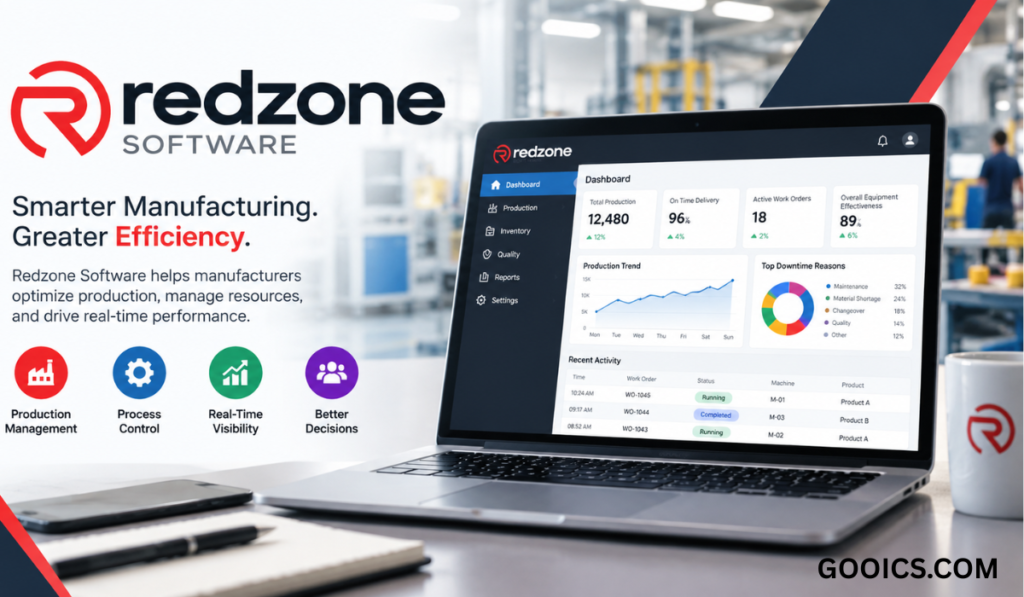

What Is Redzone Software?
Redzone (also known as QAD Redzone, following its acquisition by QAD) is a connected workforce platform built specifically for manufacturing environments. Rather than functioning as just another dashboard or reporting tool, Redzone connects production, quality, and maintenance teams in real time by combining frontline workflows, performance data, and AI insights to improve productivity, reduce downtime, and support factory-floor teams. The platform is widely used across food, beverage, and CPG production environments, where it emphasizes fast, measurable results — often within 90 days — while applying continuous improvement and lean manufacturing principles at a level not previously accessible to most plants.
What sets Redzone apart from traditional manufacturing execution systems is its philosophy. While conventional manufacturing software emphasizes dashboards and retrospective reports, Redzone is built around people and action, embedding guidance and collaboration directly into frontline workflows so problems get solved in the moment rather than reviewed after the fact.
Core Modules and Features
Redzone’s platform is organized into several core product lines, each targeting a specific area of plant performance:
Productivity — This module delivers real-time OEE (Overall Equipment Effectiveness) dashboards and AI-guided insights directly to frontline teams, with factories using it reporting an average 26% increase in productivity — the equivalent of squeezing five days of production out of four.
Compliance — Functioning as a digital quality management system, this module integrates line-side checks into QA and operator workflows, helping teams streamline processes, manage audits, simplify certification, and maintain quality standards in real time.
Reliability — Built as a CMMS on a total productive maintenance (TPM) foundation, this module reduces unplanned downtime through real-time breakdown alerts, encourages operators to take an active role in equipment care, and unifies maintenance and production on one platform with AI-assisted problem prediction.
Learning — This LMS component is designed to cut production losses and employee turnover by speeding up onboarding, improving training quality, and enabling knowledge sharing across the shop floor.
According to user reviews aggregated by software review platforms, the features manufacturers value most tend to be practical, day-to-day tools rather than back-office reporting. Downtime tracking, performance metrics, real-time monitoring, and historical trend analysis rank among the most critical features cited by Redzone users, alongside collaborative tools like in-app messaging, action tracking, and the ability to share photos or videos to resolve issues quickly.
Who Uses Redzone?
Redzone’s customer base skews heavily toward process manufacturing. Based on verified user reviews, the platform’s top industries include food production, cosmetics, and food & beverage, with common use cases spanning manufacturing, compliance, quality management, OEE tracking, and preventive maintenance. Company size ranges from small operations to large enterprises, though the platform has increasingly positioned itself as an enterprise-grade solution.
More broadly, Redzone serves manufacturers in food and beverage, consumer packaged goods, industrial manufacturing, chemicals, automotive, building materials, and life sciences — particularly operations characterized by complex processes, heavy reliance on labor, and a strong continuous improvement culture. On the enterprise side specifically, Redzone supports multi-plant, multi-region deployments, aiming to balance local plant-level flexibility with enterprise-wide standardization so large manufacturers don’t have to sacrifice consistency for adaptability.
Reported Results and ROI
Redzone’s marketing and customer testimonials consistently point to fast, quantifiable gains. The company reports that enterprise manufacturers using Redzone increase productivity by 14% within 90 days, translating to five days of production completed in just four.
Customer testimonials echo this. Terry LeDoux, Vice President at Nestlé Purina, described a pattern where roughly every seventh plant that launches Redzone effectively gains a free plant’s worth of additional capacity. Kevin Shayer, VP of Operations & Supply Chain at Allied Wire & Cable, called Redzone’s return on investment better than projected, ranking it among the most successful system implementations his company has undertaken.
Independent review data backs up these anecdotes. According to Capterra, QAD Redzone customers regularly achieve and sustain 8 to 13 points of OEE uplift following their initial 90-day deployment, driven largely by frontline collaboration and coaching rather than software alone. Individual reviewers have reported even more dramatic short-term results — one plant manager in the food and beverage sector reported reaching 65% OEE within the first 90 days of implementation, crediting real-time data and hands-on continuous improvement training.
Pricing Model
Redzone does not publish standard tiered pricing. Capterra lists the platform without a published starting price and notes that a free trial is not available, while G2 lists Redzone’s pricing simply as “custom”. Notably, part of Redzone’s value proposition is how it structures access: the platform is built on what it calls an “abundance” model, giving every employee full access without per-seat pricing, data collection limits, or other usage barriers, on the theory that broader access accelerates transformation. In practice, this means prospective buyers should expect a custom quote based on plant size, number of sites, and which modules (Productivity, Compliance, Reliability, Learning) are included.
Strengths and Common Criticisms
Review aggregators paint a largely positive but balanced picture:
Strengths:
- Onsite coaching that supports genuine operational transformation, not just software rollout
- Strong real-time productivity engagement from frontline workers
- An intuitive, visual layout that helps teams quickly understand performance metrics and act on problems
- A communication platform that breaks down departmental silos and encourages daily collaborative problem-solving
Common criticisms:
- Some users report software glitches and sensor delays
- Others note challenges with sensor reliability and limits on customization
- A few reviewers have flagged usability gaps, such as insufficient search functionality after replacing paper logs, and clunky action-filtering tools
- At least one enterprise user mentioned that certain data-mining tools don’t translate as smoothly into their standard reporting platform
Despite these critiques, aggregate sentiment remains strongly positive: Capterra’s reviews sentiment analysis shows 100% positive sentiment with no neutral or negative reviews recorded in its dataset, and G2 lists an overall rating of 4.8 out of 5 across 554 reviews.
How Redzone Differs From Traditional MES/OEE Tools
The clearest differentiator is Redzone’s emphasis on human engagement over pure data reporting. Where traditional lean consultants typically analyze an operation and deliver a report, Redzone’s coaches embed directly within the operation itself, working alongside plant teams during implementation rather than handing off recommendations from the outside.
This “coaching plus software” hybrid model is a recurring theme across customer reviews and appears to be central to why manufacturers see fast results — the platform isn’t just capturing downtime data automatically, it’s paired with structured habits (huddles, root-cause problem solving, Kaizen events) that turn that data into action.
Is Redzone Right for Your Plant?
Redzone tends to be the strongest fit for manufacturers that:
- Operate in labor-intensive, high-changeover environments (especially food, beverage, and CPG)
- Want to improve OEE without a multi-year digital transformation project
- Value frontline engagement and culture change as much as raw data capture
- Are prepared for a custom-quoted, coaching-inclusive implementation rather than a low-cost, self-serve software license
It may be less ideal for smaller operations with very limited budgets, since pricing is enterprise-oriented and not publicly listed, or for manufacturers seeking a highly customizable, build-your-own analytics platform rather than a guided, opinionated system.
Redzone Software: Frequently Asked Questions
What is Redzone software?
Redzone (also called QAD Redzone) is a connected workforce platform for manufacturers that helps production, quality, and maintenance teams collaborate in real time. It combines frontline workflows, live performance data, and AI-driven insights to improve productivity, reduce downtime, and support factory-floor teams.
Who owns Redzone software?
Redzone was acquired by QAD, an enterprise resource planning (ERP) provider for manufacturers, which is why the product is now frequently referred to as “QAD Redzone.”
What industries use Redzone software?
Redzone is most widely adopted in food production, food & beverage, and cosmetics manufacturing, though it also serves consumer packaged goods, industrial manufacturing, chemicals, automotive, building materials, and life sciences companies — particularly those with complex processes and labor-intensive operations.
What are the main modules of Redzone software?
Redzone is organized into four core products: Productivity (real-time OEE dashboards and AI insights), Compliance (a digital QMS for quality and audits), Reliability (a CMMS built on TPM principles for maintenance), and Learning (an LMS for onboarding and training).
How does Redzone software improve OEE?
Redzone customers regularly achieve and sustain 8 to 13 points of OEE uplift following their initial 90-day deployment, driven by real-time downtime tracking, frontline data capture, and structured coaching that turns data into daily action.
Does Redzone software require expensive hardware or sensors?
Redzone typically pairs its software with sensors and tablets (often iPad-based) on the plant floor for real-time data capture, though some users note occasional sensor reliability or delay issues.
How much does Redzone software cost?
Redzone does not publish standard pricing; both Capterra and G2 list its cost as custom-quoted based on plant size, number of sites, and modules selected. A free trial is not available.
Does Redzone software use a per-seat pricing model?
No. Redzone is built on what it calls an “abundance” model, giving every employee full platform access without per-seat fees or data limits, so entire workforces can use it rather than a limited number of licensed users.
How is Redzone software different from traditional manufacturing software?
Traditional manufacturing software tends to focus on dashboards and after-the-fact reports. Redzone instead embeds insights, guidance, and collaboration tools directly into frontline workflows, so problems are addressed as they happen rather than reviewed later.
Does Redzone software include implementation coaching?
Yes. Unlike traditional lean consultants who analyze an operation and hand over a report, Redzone’s coaches embed directly within the plant during rollout, working hands-on with teams to build habits like huddles and root-cause problem solving.
Can Redzone software scale across multiple plants or countries?
Yes. Redzone is designed for enterprise manufacturers running multi-site, multi-region operations, standardizing best practices globally while still allowing flexibility at the local plant level.
What results do companies typically see with Redzone software?
Reported outcomes include productivity increases of up to 26%, the equivalent of five days of production completed in four, and a reduction in employee turnover by more than a third, according to Redzone’s own published data.
What do users say are Redzone software’s biggest strengths?
Reviewers most often highlight onsite coaching, strong real-time engagement from frontline workers, an intuitive visual interface, and collaboration tools like messaging and action tracking that break down silos between departments.
What are common complaints about Redzone software?
Some users report software glitches, sensor delays, limited customization options, and usability gaps such as weaker search functionality or clunky action-filtering tools.
What is Redzone software’s average customer rating?
Redzone holds strong review scores across major platforms, including a 4.8 out of 5 rating on G2 from 554 reviews and consistently high marks on Capterra for ease of use and customer service.