
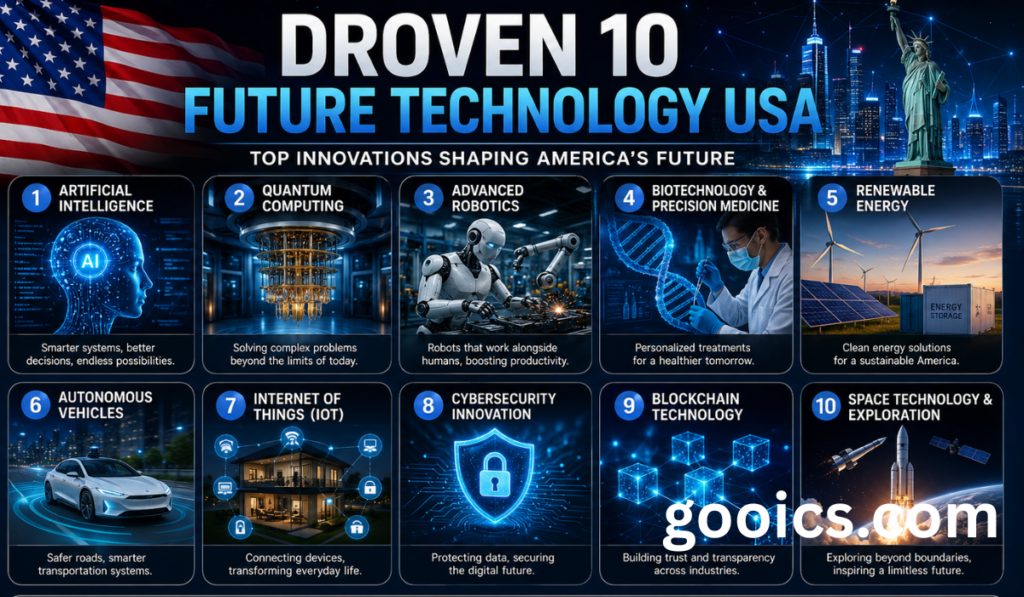

America has entered a stretch where technology isn’t just advancing — it’s converging. Artificial intelligence, robotics, energy, and biology are no longer separate stories; they’re feeding into each other, and the result is a country that’s rebuilding itself in real time. Below are ten technologies leading that shift, and what each one actually means for everyday life.
1. AI Agents That Actually Get Things Done
For years, AI meant a chatbot you talked to. Now it means software that can take a goal, break it into steps, and carry them out with minimal supervision — booking travel, managing inventory, writing and testing code, handling customer disputes. The technology works; the harder part has been redesigning business processes to actually use it well. Companies that rebuild their workflows around agents, instead of just adding AI on top of old systems, are pulling ahead of everyone else.
2. Robots With Bodies, Not Just Brains
AI is leaving the screen. Warehouses now run coordinated robot fleets that handle picking, packing, and shipping with little human input. Car factories have vehicles that drive themselves through the assembly process. And humanoid robots — general-purpose machines that can walk, grip, and adapt to unpredictable spaces — are starting to show up in logistics centers and even early caregiving settings. This is often called “physical AI,” and it’s arguably the biggest shift in robotics in decades.
3. Quantum Computing Gets Practical
Quantum computers aren’t going to replace your laptop, but they are starting to solve real problems that classical computers struggle with — simulating new materials, accelerating drug discovery, optimizing complex logistics networks. The U.S. is also racing to build “quantum-safe” encryption before quantum machines become powerful enough to crack today’s security standards.
4. Batteries That Charge in Minutes, Not Hours
The biggest bottleneck in the electric vehicle era — slow charging and range anxiety — is starting to disappear. New battery chemistries using silicon-carbon and sodium are delivering faster charging, longer range, and far better performance in cold weather, all while relying less on scarce materials like lithium. This isn’t a lab curiosity; it’s already reaching production vehicles and consumer electronics.
5. Cars, Trucks, and Delivery Robots That Drive Themselves
Autonomous vehicles have quietly become part of daily infrastructure in several U.S. cities, running passenger trips around the clock. The next frontier is freight — self-driving trucks and delivery robots that could meaningfully cut logistics costs and reshape how goods move across the country.
6. Medicine That Predicts Illness Before It Happens
Biotechnology is shifting from treating disease to preventing it. Gene-editing tools like CRISPR are producing real results for conditions once thought untreatable, while AI models trained on genetic and health data can flag risk factors years before symptoms appear. The goal isn’t just better treatment — it’s catching problems before they start.
7. Space as the New Data Frontier
Space is becoming infrastructure, not just exploration. Phones are starting to connect directly to satellites in places with no cell coverage, and falling launch costs are opening the door to an unexpected idea: data centers in orbit, where the vacuum of space offers free cooling and constant solar power. Early orbital AI experiments have already proven the concept works.
8. AR and VR Finally Find Their Purpose
Extended reality has moved past gaming into practical, everyday use. Surgeons train in VR before operating on real patients. Factory workers use AR overlays to guide precise assembly. Retailers let shoppers try products virtually before buying. Lighter, smarter AI-powered glasses are making this technology far more wearable — and far less of a novelty.
9. Cybersecurity That Stops Threats Before They Strike
As AI speeds everything up, it’s speeding up cyberattacks too. In response, security systems are shifting from reactive (detect the breach, then respond) to preemptive (predict and block the threat before it happens). A related trend, digital provenance, is helping verify whether content, data, or software is genuinely what it claims to be — a growing necessity as AI-generated content becomes harder to distinguish from the real thing.
10. Cities That Respond in Real Time
Powered by faster 5G networks and edge computing, American cities are beginning to run themselves more intelligently — traffic lights that adjust to real congestion, waste routes that optimize on the fly, energy grids that balance load automatically. Because the data is processed locally instead of routed to a distant server, these systems can react in milliseconds, which is exactly what’s needed as autonomous vehicles and robots start sharing the same streets.
Where This Is All Heading
The common thread across all ten of these technologies is speed of adoption. What used to take a decade to go from lab to living room is now happening in a few years. The USA isn’t just inventing this future — it’s actively building the infrastructure, regulations, and business models to live in it. For anyone paying attention, the smartest move isn’t to wait and see. It’s to understand these shifts now, because by the time they’re common knowledge, they’ll already be common practice.
FAQs: Future Technology in the USA
1. What are the top future technologies in the USA right now? The biggest ones gaining real-world traction include agentic AI, physical AI and humanoid robotics, quantum computing, next-generation batteries, autonomous vehicles, biotechnology and precision medicine, space-based infrastructure, extended reality (AR/VR), AI-driven cybersecurity, and smart city systems powered by edge computing.
2. What is agentic AI, and how is it different from a chatbot? A chatbot answers questions when prompted. An AI agent can plan and carry out multi-step tasks on its own — like managing a workflow, booking travel, or debugging code — checking in with a human only when necessary. Agentic AI is considered the next major leap beyond today’s generative AI tools.
3. Is quantum computing actually being used yet, or is it still experimental? Both. Large-scale, general-purpose quantum computers are still years away, but specific applications — like drug discovery, materials science, and optimization problems — are already seeing real quantum-assisted results. It’s moving from pure research into targeted, practical use.
4. Why is battery technology considered a “future tech” trend? New battery chemistries, such as silicon-carbon anodes and sodium-based alternatives to lithium-ion, are solving long-standing problems: slow charging, poor cold-weather performance, and reliance on scarce materials. These improvements directly affect EVs, phones, and wearables that people use every day.
5. Are self-driving cars actually operating in US cities today? Yes. Robotaxis now run around the clock in a number of major U.S. metro areas, and autonomous trucking and delivery robots are expanding as well. The technology has moved from testing phases into daily operation in specific markets.
6. How is AI changing healthcare in the US? AI is shifting medicine from reactive treatment to proactive prevention. Tools built on genomic data can flag disease risk before symptoms appear, while AI-assisted drug discovery is shortening development timelines. Gene-editing therapies, including CRISPR-based treatments, are also producing real clinical results.
7. What does “space as computing infrastructure” mean? It refers to using space for more than exploration or communications. Satellite-to-phone connectivity is expanding coverage on Earth, while early experiments are testing whether data centers could eventually run in orbit, taking advantage of natural cooling and constant solar power.
8. Is extended reality (AR/VR) actually being used outside of gaming? Yes. Hospitals use VR for surgical training, manufacturers use AR to guide complex assembly work, and retailers let customers try products virtually before buying. Smart glasses are also becoming more affordable and AI-powered, pushing XR toward everyday use.
9. How is cybersecurity evolving alongside AI? Security is shifting from reactive (detecting breaches after they happen) to preemptive, using AI to identify and stop threats before they strike. There’s also growing focus on “digital provenance” — verifying that content or data actually comes from where it claims to, which matters more as AI-generated content becomes harder to detect.
10. What role does 5G and edge computing play in future technology? Edge computing processes data locally instead of sending it to a distant data center, which allows for near-instant response times. Combined with faster 5G networks, this is what makes real-time systems possible — smart traffic lights, responsive energy grids, and autonomous robots operating safely on shared city streets.
11. Which of these technologies will have the biggest impact on everyday Americans? Agentic AI and autonomous vehicles are likely to be the most visibly disruptive in the near term, since they directly touch how people work and get around. Battery technology and biotech, meanwhile, will have a quieter but equally significant impact on daily life through better devices and preventive healthcare.
12. Is the US leading globally in these technologies? The US holds a strong lead in AI, quantum computing, and biotech investment, though it faces increasing competition from countries like China, particularly in robotics, EV batteries, and next-generation telecom infrastructure. Leadership varies by sector rather than being uniform across the board.