
Choosing a username feels simple until you actually sit down to do it. You type something in, find it’s already taken, try a variation, get rejected again, and twenty minutes later you’re staring at a blank field wondering why “James” of all names is so hard to claim online. This is where a username generator earns its place as one of the most underrated tools on the internet.
Whether you’re signing up for a gaming platform, setting up a professional email, launching a social media presence, or just want a fresh handle that isn’t “user48291,” a good username generator can save you time, spark ideas, and help you land on something that actually represents you.
What Is a Username Generator?
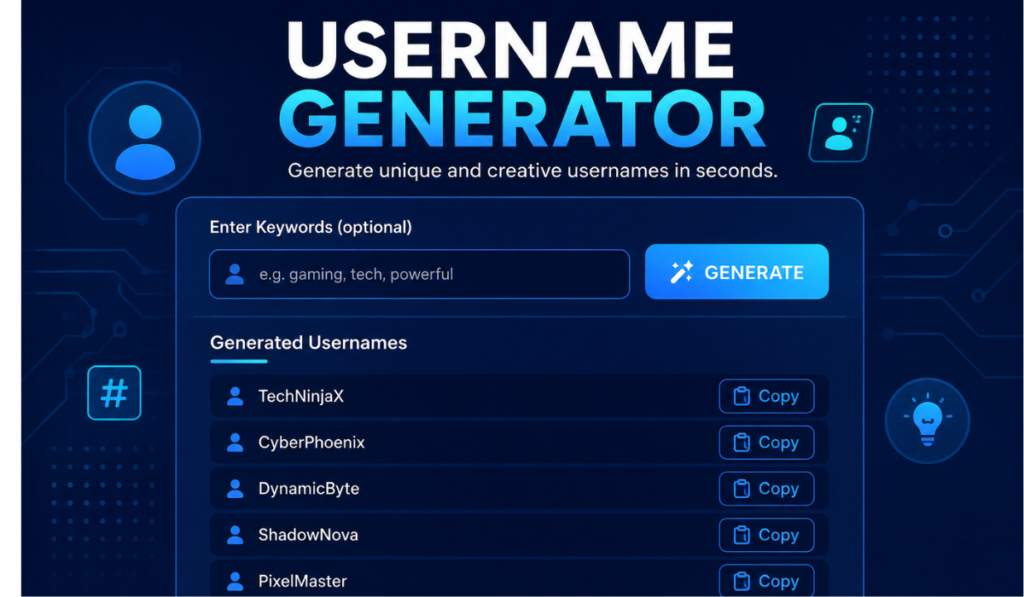
A username generator is a tool that automatically creates unique, available, and often creative usernames based on your input — such as your name, interests, favorite words, or a chosen theme. Instead of brainstorming from scratch, you feed the tool a few keywords or preferences, and it produces a list of ready-to-use options, often combined with numbers, symbols, or stylistic variations to ensure originality.
These tools range from simple random-word combiners to sophisticated generators that check real-time availability across platforms like Instagram, X (formerly Twitter), TikTok, Discord, Roblox, and Gmail.
Why Use a Username Generator?
1. It Saves Time
Manually brainstorming a username that isn’t taken can eat up far more time than it should. A generator produces dozens of options in seconds, cutting the guesswork out entirely.
2. It Sparks Creativity
Sometimes the hardest part isn’t finding an available name — it’s coming up with an idea at all. Generators combine words, syllables, and themes in ways you might never think of yourself, often leading to a name you genuinely like more than anything you’d have typed manually.
3. It Helps with Consistency Across Platforms
If you want the same handle on Instagram, Twitter, Discord, and YouTube, a generator that checks cross-platform availability makes it far easier to lock down a consistent brand identity.
4. It Improves Privacy and Security
A randomly generated username — rather than one based on your real name or birthdate — makes it harder for strangers to identify or track you online. This is especially useful for gaming accounts, forums, or any platform where you’d rather stay anonymous.
5. It’s Great for Branding
Content creators, streamers, and small business owners often need a catchy, memorable handle. A generator tailored to your niche (gaming, beauty, tech, fitness) can suggest names that already sound “on brand.”
Types of Username Generators
Random Generators These combine adjectives, nouns, and numbers at random — great for quick, no-frills results (e.g., “SwiftFalcon82”).
Themed Generators Built around a specific niche like gaming, anime, fantasy, or aesthetic styles, these produce names that fit a particular vibe (e.g., “ShadowRogueX” for gaming, “MoonlitPetal” for a soft aesthetic).
Name-Based Generators These take your real name or nickname and transform it using creative formatting, added words, or stylish fonts (e.g., “Alex” becomes “Alex.codes” or “TheRealAlexT”).
Business/Brand Generators Designed for professionals and entrepreneurs who need a handle that’s catchy, brandable, and consistent with a domain name or business identity.
Platform-Specific Generators Some tools are built specifically for Instagram, TikTok, Discord, Roblox, or Xbox Live, taking into account each platform’s character limits and formatting rules.
Tips for Choosing the Perfect Username
- Keep it memorable. Short, pronounceable names are easier for people to recall and search for.
- Think long-term. Avoid usernames tied to a specific age, trend, or fandom you might outgrow.
- Check availability everywhere. Before committing, search the name across the platforms you actually plan to use.
- Avoid personal details. Skip birth years, addresses, or anything that could compromise your privacy.
- Match your purpose. A professional LinkedIn handle should look different from a gaming tag — tailor the tone to the platform.
- Test how it reads aloud. If you’ll ever need to say your username out loud (in a stream, interview, or intro), make sure it doesn’t sound awkward.
Common Use Cases
| Use Case | What to Look For |
|---|---|
| Gaming (Xbox, PlayStation, Roblox, Steam) | Bold, catchy, easy to type mid-game |
| Social Media (Instagram, TikTok, X) | Consistent across platforms, brand-friendly |
| Professional (Email, LinkedIn, GitHub) | Clean, credible, tied loosely to your real name |
| Anonymous Forums (Reddit, Discord) | Unique, privacy-conscious, unrelated to real identity |
| Content Creation (YouTube, Twitch) | Memorable, niche-relevant, easy to search |
Final Thoughts
A username might seem like a small detail, but it’s often the first impression you make online — whether you’re joining a Discord server, launching a YouTube channel, or just signing up for a new app. A username generator takes the pressure off, offering instant inspiration and saving you from the frustration of endless “this name is already taken” messages.
The best approach is to treat the generator as a starting point: let it do the heavy lifting, then tweak the result until it feels genuinely like you. A little customization goes a long way toward turning a random suggestion into a name you’ll be happy to use for years to come.
Username Generator: Frequently Asked Questions
1. What is a username generator? A username generator is a tool that automatically creates unique, creative, and often available usernames based on your input, such as a name, interests, or keywords — saving you from brainstorming one manually.
2. Is a username generator free to use? Most username generators are free and require no sign-up. Some advanced tools may offer premium features like real-time cross-platform availability checks.
3. Can I use a username generator for any platform? Yes. Generated usernames can generally be used on any platform — social media, gaming, email, forums, and more — as long as they meet that platform’s specific formatting rules (character limits, allowed symbols, etc.).
4. How does a username generator create names? Most tools combine words, syllables, numbers, or your input keywords using algorithms or random pairing to produce unique, pronounceable name options.
5. Will the generated username definitely be available? Not always. Basic generators just produce name ideas without checking availability, while more advanced tools check in real time across specific platforms like Instagram, Discord, or Gmail.
6. Can I customize the results? Yes. Most generators let you enter keywords, choose a theme (gaming, aesthetic, professional, etc.), or select a name style to guide the suggestions toward what you’re looking for.
7. Are username generators good for privacy? Yes. Using a randomly generated username instead of your real name helps protect your identity and makes it harder for others to trace your online activity back to you.
8. Can I use a username generator for business or branding purposes? Yes. Many generators are designed specifically for branding, producing catchy, professional names suitable for businesses, content creators, or personal branding.
9. Do username generators work for gaming usernames? Absolutely. Many generators offer gaming-specific modes that produce bold, catchy tags suitable for platforms like Steam, Xbox, PlayStation, or Roblox.
10. Can I generate a username based on my real name? Yes. Name-based generators take your actual name or nickname and creatively modify it with added words, symbols, or stylized formatting.
11. How many username options does a generator usually provide? This varies by tool, but most generators produce anywhere from 5 to 50+ suggestions per search, often with the option to regenerate for more results.
12. Should I edit the generated username before using it? It’s a good idea. Treat the generator’s output as a starting point — tweaking it slightly can make the name feel more personal while keeping it unique and available.