
Introduction
Three years ago, picking an AI assistant mostly meant picking whichever one you’d heard of first. That’s no longer true. Claude, ChatGPT, and Gemini have each matured into distinct products with real strengths and real blind spots, and by 2026 the gap in raw model quality between the top-tier options has narrowed to the point where cost, context window, ecosystem, and specific use case matter more than which one scores a point or two higher on a benchmark. This article compares all three across the areas that actually affect day-to-day use, rather than trying to crown one universal winner.
The Three Players, in Brief
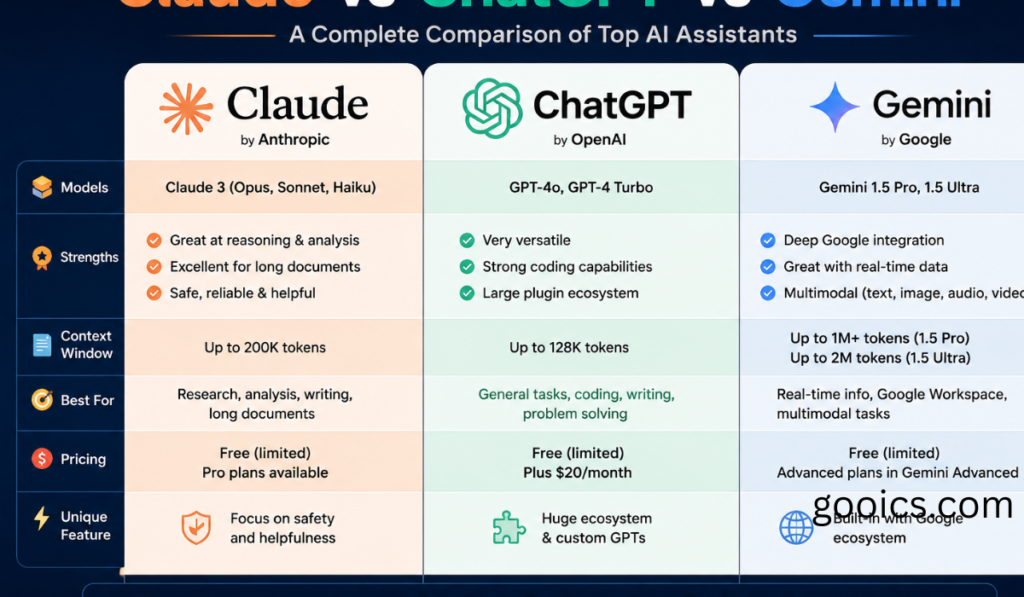
- ChatGPT (OpenAI) is the most widely recognized AI assistant and has the broadest ecosystem of integrations, plugins, and multimodal features, including image generation and voice.
- Claude (Anthropic) has developed a reputation as a specialist in careful reasoning, long-document handling, natural writing, and coding accuracy, generally with a more direct, less over-agreeable tone.
- Gemini (Google) is closely tied into the Google Workspace ecosystem and tends to lead in multimodal tasks and very large context windows, making it a natural fit for users already living inside Gmail, Docs, and Drive.
Writing Quality
Independent blind tests — where evaluators rate outputs without knowing which model produced them — have generally found Claude scoring strongest on writing-focused tasks, with reviewers describing its prose as more natural and less repetitive than the other two. ChatGPT has performed competitively on structured, business-style writing tasks, while Gemini has generally placed consistently across categories without leading outright in writing quality specifically.
Coding and Technical Work
Across developer surveys and coding-specific benchmarks in 2026, Claude has generally rated highest for complex coding tasks and large codebase work, particularly through tools like Claude Code. ChatGPT remains strong for quick snippets, general-purpose coding help, and data analysis through its code execution features. Gemini is capable at coding but is generally described as less specialized for development work specifically compared to the other two.
Reasoning and Problem-Solving
This is one area where the ranking shifts. Some 2026 benchmarks show Gemini leading on advanced, graduate-level reasoning problem sets, with ChatGPT’s latest models also scoring very highly on structured analytical tasks. This is a useful reminder that “best overall” doesn’t hold consistently across every category — a tool that leads in writing or coding isn’t automatically the strongest at abstract reasoning tasks.
Context Window and Long-Document Handling
Context window size — how much text a model can consider at once — varies meaningfully between the three, and providers have been expanding this quickly. Claude has built a reputation for reliable performance even at large context sizes, which matters for tasks like analyzing lengthy contracts or research documents. Gemini has generally offered some of the largest raw context windows of the three, though quality can vary at the very upper end of that range. ChatGPT’s context window has also grown substantially, narrowing what used to be a clearer gap between the three.
Multimodal Capabilities
Gemini and ChatGPT both have stronger native multimodal support — including image generation, video-related tasks, and voice interaction — compared to Claude, which has historically focused more narrowly on text, reasoning, and document-based work. If your use case regularly involves generating images or working with video, this is one of the more clear-cut differentiators rather than a close call.
Ecosystem and Integrations
ChatGPT generally has the most mature third-party plugin ecosystem and broad integration options. Gemini’s biggest ecosystem advantage is its deep, native integration with Google Workspace tools like Docs, Sheets, and Gmail, which matters a great deal if your organization already lives inside that ecosystem. Claude’s ecosystem has grown as well, particularly around developer and agentic tooling, but it’s generally seen as more narrowly focused than the other two.
Pricing
At the individual consumer level, pricing across all three is close to identical — generally around $20/month for the standard paid tier, with limited free tiers available on each. The more meaningful differences show up at the API and enterprise level, where per-token costs, context window pricing, and business plan structures vary more significantly between providers.
How to Choose
Rather than picking a single “best” model, most current comparisons suggest matching the tool to your primary use case:
- Choose Claude if your priority is writing quality, coding accuracy, or working through long documents with consistent reliability.
- Choose ChatGPT if you want the broadest general-purpose tool with strong multimodal features and the widest ecosystem of integrations.
- Choose Gemini if you’re deeply embedded in the Google Workspace ecosystem or need strong multimodal and large-context capabilities.
Many professionals and teams don’t limit themselves to just one. A common pattern is using each tool for what it does best — for example, drafting and analysis in Claude, everyday brainstorming and images in ChatGPT, and Workspace-integrated tasks in Gemini — since running more than one costs relatively little compared to the time it can save.
Conclusion
In 2026, Claude, ChatGPT, and Gemini have converged in overall capability while diverging in specialty: Claude for writing and coding depth, ChatGPT for general-purpose breadth and ecosystem, and Gemini for multimodal strength and Google integration. The most useful question isn’t which one is “best” in the abstract, but which one’s strengths line up with the specific work you’re trying to get done — and increasingly, the honest answer for many users is more than one.
FAQs:Claude vs ChatGPT vs Gemini
1. Which is better overall: Claude, ChatGPT, or Gemini? There’s no single universal winner — Claude tends to lead in writing and coding, ChatGPT in general-purpose breadth and ecosystem, and Gemini in multimodal tasks and Google Workspace integration.
2. Which AI is best for writing? Independent blind tests have generally rated Claude highest for writing quality, with reviewers describing its prose as more natural, though ChatGPT performs well on structured business writing.
3. Which AI is best for coding? Claude has generally rated highest for complex coding tasks and large codebases in developer surveys and benchmarks, particularly with tools like Claude Code, though the gap with top competitors is often narrow.
4. Which AI is best for reasoning and problem-solving? Some 2026 benchmarks show Gemini leading on advanced reasoning tasks, with ChatGPT also scoring very highly on structured analytical problems — this is one area where the ranking shifts from writing and coding.
5. Which AI has the largest context window? Context windows have grown significantly across all three, with Gemini generally offering some of the largest raw context sizes, though quality can vary at the very upper end.
6. Which AI is best for images and multimodal tasks? Both Gemini and ChatGPT have stronger native multimodal support, including image generation and video-related tasks, compared to Claude’s more text- and document-focused approach.
7. Which AI integrates best with everyday work tools? Gemini has the deepest native integration with Google Workspace (Docs, Sheets, Gmail), while ChatGPT generally has the broadest third-party plugin ecosystem overall.
8. Do Claude, ChatGPT, and Gemini cost the same? At the individual level, yes — all three are generally priced around $20/month for their standard paid tier, with differences showing up more at the API and enterprise pricing level.
9. Can I use more than one of these AI tools at once? Yes, many professionals use a combination — for example, Claude for writing and analysis, ChatGPT for brainstorming and images, and Gemini for Workspace-integrated tasks — since running more than one is relatively inexpensive.
10. How should I decide which one to use? Match the tool to your primary task: Claude for writing/coding/long documents, ChatGPT for general-purpose use and integrations, and Gemini for multimodal work or deep Google ecosystem needs.