

Introduction
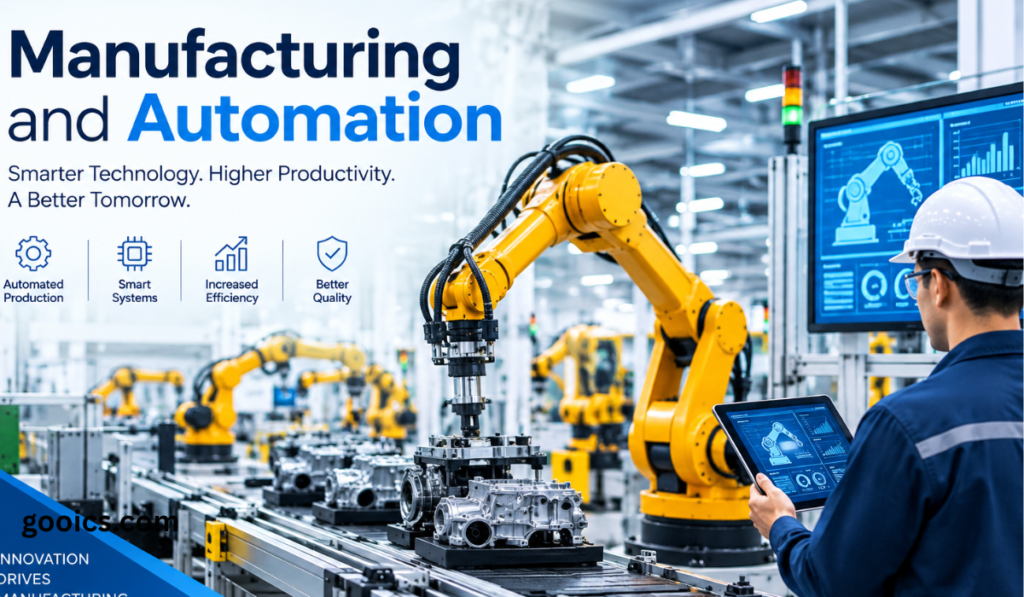
Manufacturing has always advanced by finding better ways to make things: the assembly line, interchangeable parts, numerical control. Today the next shift is automation, and it goes well beyond robots bolted to a factory floor. Modern manufacturing and automation combine robotics, sensors, software, data analytics and artificial intelligence to make production faster, more consistent, safer and more flexible.
For manufacturers facing labor shortages, rising costs, tighter quality requirements and unpredictable demand, automation is no longer a luxury reserved for large corporations. It is becoming a core competitive capability. This article explains what manufacturing automation really is, the technologies behind it, the benefits and risks, and a realistic path to adoption.
What Is Manufacturing Automation?
Manufacturing automation is the use of machines, control systems and software to perform production tasks with minimal human intervention. It exists on a spectrum:
- Fixed automation: Equipment designed for one high-volume product, such as a dedicated bottling line. It is extremely efficient but hard to change.
- Programmable automation: Machines such as CNC tools and industrial robots that can be reprogrammed for different products or batches.
- Flexible automation: Systems that switch between product variants quickly with little downtime, often guided by software and sensor feedback.
- Intelligent automation: Systems that use data and AI to adapt in real time, detect problems and optimize themselves.
Most factories use a mix of all four, and the goal is rarely to remove people entirely. It is to put machines on repetitive, dangerous or precision-critical work, and people on judgment, problem-solving and improvement.
The Core Technologies Driving Automation
Industrial Robots and Cobots
Traditional industrial robots handle welding, painting, palletizing and heavy material handling at high speed behind safety cages. Collaborative robots, or cobots, are smaller, easier to program and designed to work alongside people. Their lower cost and fast setup make them especially attractive to small and mid-sized manufacturers.
Programmable Logic Controllers and Control Systems
PLCs, SCADA systems and distributed control systems are the nervous system of the plant. They read inputs from sensors, run control logic and command actuators, keeping processes stable and repeatable.
Industrial IoT and Sensors
The Industrial Internet of Things connects machines, tools and products to networks. Sensors capture temperature, vibration, pressure, energy use, throughput and more, creating a continuous stream of data about what is actually happening on the floor.
Machine Vision
Cameras paired with image-processing software inspect parts, read barcodes, guide robots and detect defects at speeds and consistency levels no human inspector can match.
Artificial Intelligence and Machine Learning
AI turns data into decisions. Common uses include predictive maintenance, demand forecasting, automated visual inspection, process parameter optimization and production scheduling.
Digital Twins and Simulation
A digital twin is a virtual model of a machine, line or entire factory. Teams can test layout changes, simulate new products and train operators before touching physical equipment, reducing risk and commissioning time.
Additive Manufacturing and Autonomous Mobile Robots
3D printing automates the production of complex parts and tooling, while autonomous mobile robots (AMRs) move materials between stations without fixed conveyors or guide tracks, making intralogistics more flexible.
Key Benefits of Automation in Manufacturing
Higher productivity. Machines run continuously, maintain consistent cycle times and reduce idle gaps between steps.
Better and more consistent quality. Automated processes reduce variation. Inline inspection catches defects early, lowering scrap and rework.
Lower unit costs over time. Although upfront investment is real, automation typically reduces labor per unit, waste, rework and energy use.
Improved safety. Robots take on tasks involving heavy loads, extreme heat, hazardous materials or repetitive strain, reducing workplace injuries.
Greater flexibility and resilience. Software-defined production lets manufacturers handle smaller batches, more variants and faster changeovers, which matters as customers expect customization.
Data-driven decision making. Real-time visibility into overall equipment effectiveness (OEE), downtime causes and quality trends replaces guesswork with evidence.
Addressing labor shortages. Many manufacturers struggle to hire skilled workers. Automation helps maintain output while freeing staff for higher-value roles.
Real-World Applications
- Automotive: Robotic welding and assembly, vision-guided quality checks and fully connected production lines.
- Electronics: High-speed pick-and-place machines, automated optical inspection and cleanroom handling.
- Food and beverage: Automated filling, packaging, sorting and traceability systems that support hygiene and compliance.
- Pharmaceuticals: Closed, validated automated processes that reduce contamination risk and document every batch.
- Metalworking and machining: Lights-out CNC cells with automated part loading and tool monitoring.
- Textiles, plastics and consumer goods: Automated cutting, molding, inspection and packing to improve consistency and speed.
Challenges and Risks to Plan For
Automation delivers results only when it is planned carefully. Common obstacles include:
- High initial investment. Equipment, integration, training and facility changes add up. Return on investment must be modeled realistically.
- Integration complexity. Legacy machines, mixed vendors and disconnected data systems make connecting everything harder than buying the hardware.
- Skills gap. Technicians who understand mechatronics, controls, data and software are in high demand.
- Cybersecurity. Connecting operational technology to networks expands the attack surface. Segmentation, access control and monitoring are essential.
- Change management. Employees may fear job loss. Without clear communication and training, adoption stalls.
- Automating a bad process. Automation amplifies whatever it is applied to. A wasteful process automated is simply a faster wasteful process.
How to Start: A Practical Roadmap
Step 1: Fix and standardize the process first. Apply lean principles to remove waste and document the best-known method before adding technology.
Step 2: Identify high-value opportunities. Look for tasks that are repetitive, ergonomically harmful, quality-critical or bottlenecks. Prioritize by impact and feasibility.
Step 3: Build the business case. Estimate savings from labor, scrap, downtime and throughput, plus costs for equipment, integration, training and maintenance. Calculate payback period and total cost of ownership.
Step 4: Start with a pilot. Choose one cell or line, define measurable goals, and learn before scaling. Cobots and vision systems are often good first projects.
Step 5: Get your data foundation right. Connect machines, standardize data collection and track OEE. Data you trust makes every later project easier.
Step 6: Invest in people. Train operators, maintenance staff and engineers. Involve the shop floor early so the people closest to the process shape the solution.
Step 7: Secure and scale. Build cybersecurity into the design, document standards, and replicate successful pilots across the plant or network.
The Future of Manufacturing and Automation
Several trends are shaping what comes next:
- AI-driven autonomy: Systems that not only detect problems but also adjust process parameters on their own.
- Software-defined factories: Production lines reconfigured through software rather than physical rework.
- Human-robot collaboration: Easier programming through natural language, demonstration and intuitive interfaces.
- Sustainable manufacturing: Automation and analytics reducing energy consumption, material waste and emissions.
- Resilient, localized supply chains: Automation making domestic and regional production more economically competitive.
- Connected ecosystems: Factories sharing data with suppliers and customers for tighter planning and traceability.
The factory of the near future will be less about replacing people and more about augmenting them: workers supported by intelligent tools, real-time insight and machines that handle the repetitive work.
Conclusion
Manufacturing and automation are now inseparable. Companies that automate thoughtfully gain higher quality, better safety, lower costs and the agility to respond to a changing market. The winners will not necessarily be those who spend the most, but those who choose the right problems, build strong data and people foundations, and scale what works.
Start small, measure honestly, and keep improving. Automation is not a single project with an end date. It is an ongoing capability that compounds over time.
Frequently Asked Questions
What is the difference between manufacturing and automation? Manufacturing is the process of making goods. Automation is the use of technology to perform parts of that process with minimal human effort.
Does automation eliminate manufacturing jobs? It changes them. Some repetitive roles shrink, while demand grows for technicians, programmers, data analysts and maintenance specialists.
Is automation only for large manufacturers? No. Cobots, modular systems and subscription-based software have made automation accessible and affordable for small and mid-sized companies.
How long does it take to see a return on investment? It varies by project, but many targeted automation projects aim for payback within one to three years, depending on volume, labor cost and complexity.
What is the best first automation project? Usually a repetitive, high-volume or ergonomically difficult task with a clear, measurable outcome, such as palletizing, machine tending or visual inspection.