
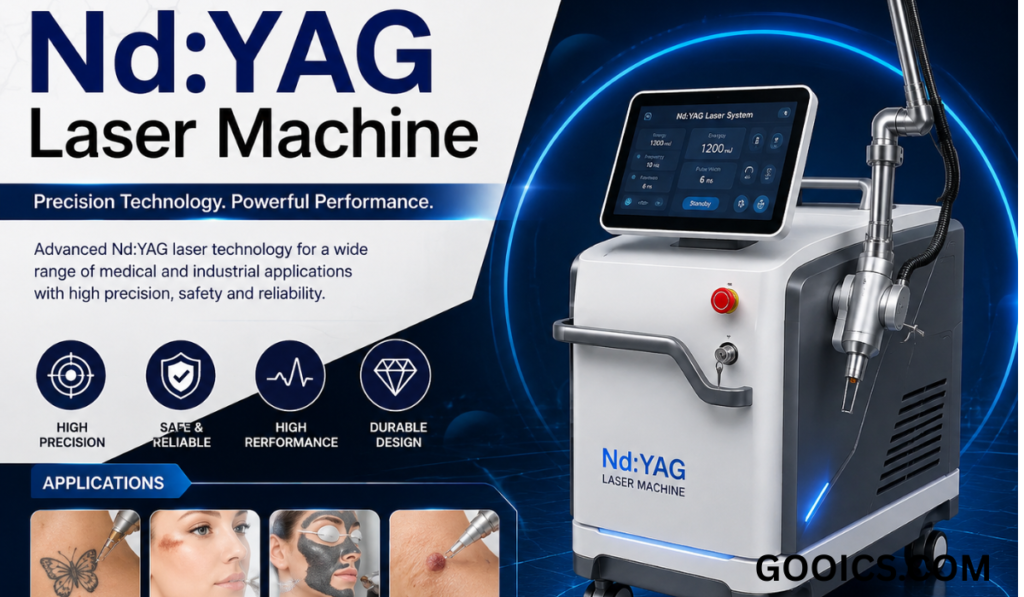

Laser technology has transformed countless industries — from medical treatments to industrial manufacturing — and one of the most versatile and widely used laser systems today is the Nd YAG laser machine. Known for its precision, efficiency, and adaptability, this laser type has become a go-to solution across dermatology, cosmetic treatments, jewelry making, metal marking, and even scientific research.
In this article, we’ll break down what an Nd YAG laser machine is, how it works, its key applications, and why it continues to be a preferred choice across multiple industries.
What is an Nd YAG Laser Machine?
Nd YAG stands for Neodymium-doped Yttrium Aluminum Garnet, which refers to the crystal used as the laser’s gain medium. This crystal is doped with neodymium ions, which get excited by a pump source (usually a flash lamp or diode) to produce a powerful, focused beam of light — typically at a wavelength of 1064 nm, though frequency-doubled versions can emit at 532 nm (green light) as well.
Because of its solid-state design, an Nd YAG laser machine is known for being durable, energy-efficient, and capable of producing high peak power in short pulses — making it ideal for tasks requiring deep tissue penetration or precise material interaction.
How Does an Nd YAG Laser Machine Work?
At its core, the machine works through a process called stimulated emission:
- A pump source energizes the neodymium ions within the YAG crystal.
- These excited ions release photons as they return to a lower energy state.
- The photons bounce between mirrors in a resonator cavity, amplifying the light.
- The resulting laser beam exits through a partially reflective mirror, delivering concentrated energy to the target surface.
Depending on the settings, the laser can operate in continuous wave (CW) mode or pulsed mode, giving operators flexibility for different applications — from gentle skin treatments to powerful metal engraving.
Key Applications of Nd YAG Laser Machines
1. Medical and Cosmetic Treatments
Nd YAG lasers are widely used in dermatology and aesthetic clinics for:
- Laser hair removal (especially effective on darker or coarser hair)
- Tattoo removal
- Treating vascular lesions and pigmentation issues
- Skin resurfacing and rejuvenation
Their deeper wavelength allows them to target tissue beneath the skin’s surface while minimizing damage to surrounding areas — making treatments safer and more effective, especially for a wider range of skin tones.
2. Industrial Laser Marking and Engraving
In manufacturing, Nd YAG laser machines are commonly used for:
- Marking serial numbers, logos, and barcodes on metal, plastic, and ceramic
- Engraving jewelry with intricate, permanent designs
- Cutting and welding thin metal sheets with high precision
Their ability to deliver high peak power in short bursts makes them excellent for applications requiring accuracy without excessive heat damage to surrounding material.
3. Scientific and Research Use
Nd YAG lasers are also a staple in research labs, used in spectroscopy, non-linear optics, and as pump sources for other laser systems like Ti:Sapphire lasers.
Advantages of Nd YAG Laser Machines
- High Power Output: Capable of delivering strong energy pulses suitable for both delicate and heavy-duty tasks.
- Versatility: Works effectively across medical, industrial, and research applications.
- Deep Penetration: The 1064 nm wavelength allows treatment or processing beneath surface layers.
- Durability: Solid-state crystal design means longer operational lifespan compared to some other laser types.
- Precision: Minimal thermal damage to surrounding areas, ensuring clean, accurate results.
Things to Consider Before Buying an Nd YAG Laser Machine
If you’re considering investing in an Nd YAG laser machine — whether for a clinic or industrial use — keep the following in mind:
- Intended Application: Medical-grade machines differ significantly from industrial marking systems in calibration and safety features.
- Power and Pulse Settings: Ensure the machine offers adjustable settings suited to your specific treatments or materials.
- Certification and Compliance: For medical use, confirm the machine meets relevant health and safety regulatory standards.
- Maintenance Requirements: Solid-state lasers generally require less maintenance, but routine servicing is still essential for consistent performance.
- Training: Proper operator training is critical, especially in medical settings, to ensure safe and effective use.
Final Thoughts
The Nd YAG laser machine remains one of the most trusted and versatile laser technologies available today, bridging the gap between precision medical treatments and robust industrial applications. Its combination of power, depth of penetration, and adaptability makes it a valuable tool whether you’re running a dermatology clinic, a jewelry engraving business, or a manufacturing facility.
As laser technology continues to evolve, Nd YAG systems are likely to remain a cornerstone — proving that sometimes, the most reliable tools are the ones that adapt across the widest range of needs.
FAQS “Nd YAG Laser Machine”:
1. What is an Nd YAG laser machine used for?
An Nd YAG laser machine is used for a wide range of applications, including laser hair removal, tattoo removal, skin rejuvenation, metal marking and engraving, jewelry engraving, and precision cutting or welding in industrial settings.
2. What does “Nd YAG” stand for?
Nd YAG stands for Neodymium-doped Yttrium Aluminum Garnet, which refers to the crystal used inside the laser as its gain medium to produce the laser beam.
3. Is Nd YAG laser safe for all skin types?
Yes, Nd YAG lasers are generally considered safe for a wider range of skin tones, including darker skin, because their longer wavelength (1064 nm) bypasses melanin in the skin’s surface and targets deeper tissue with reduced risk of pigmentation damage.
4. How does an Nd YAG laser machine work?
The machine works by exciting neodymium ions within a YAG crystal using a pump source, which then release energy in the form of light. This light is amplified inside a resonator cavity and released as a concentrated laser beam.
5. What is the wavelength of an Nd YAG laser?
The standard wavelength is 1064 nm, though frequency-doubled versions can also emit at 532 nm, which is used for different treatment or marking purposes.
6. Can Nd YAG laser machines be used for industrial purposes?
Yes, Nd YAG lasers are widely used in industrial applications such as metal marking, engraving, cutting thin materials, and laser welding due to their high precision and power output.
7. Is Nd YAG laser treatment painful?
Most patients report mild discomfort, often described as a warm tingling or snapping sensation, but many modern machines include cooling systems to minimize pain during treatment.
8. How many sessions are needed for laser hair removal with Nd YAG?
Typically, 6 to 8 sessions are recommended for optimal results, though this can vary depending on hair type, skin tone, and treatment area.
9. What is the difference between Nd YAG and other laser types (like Alexandrite or Diode)?
Nd YAG lasers penetrate deeper into the skin and are safer for darker skin tones, while Alexandrite and Diode lasers are often more effective on lighter skin with finer hair, but carry higher risk of pigmentation issues on darker skin.
10. How long does an Nd YAG laser machine last?
With proper maintenance, Nd YAG laser machines can last several years, as their solid-state design generally requires less frequent servicing compared to other laser technologies.
11. Is training required to operate an Nd YAG laser machine?
Yes, proper training is essential, especially for medical and cosmetic use, to ensure safe operation, correct settings, and effective treatment outcomes.
12. Can Nd YAG lasers remove tattoos completely?
In many cases, yes — Nd YAG lasers are effective at breaking down tattoo ink particles, especially black and dark-colored inks, though multiple sessions are usually required for full removal.
Want me to expand this into a downloadable FAQ document, add FAQ schema markup for SEO, or tailor the questions specifically for medical/aesthetic use or industrial use?
Want to be notified when Claude responds?