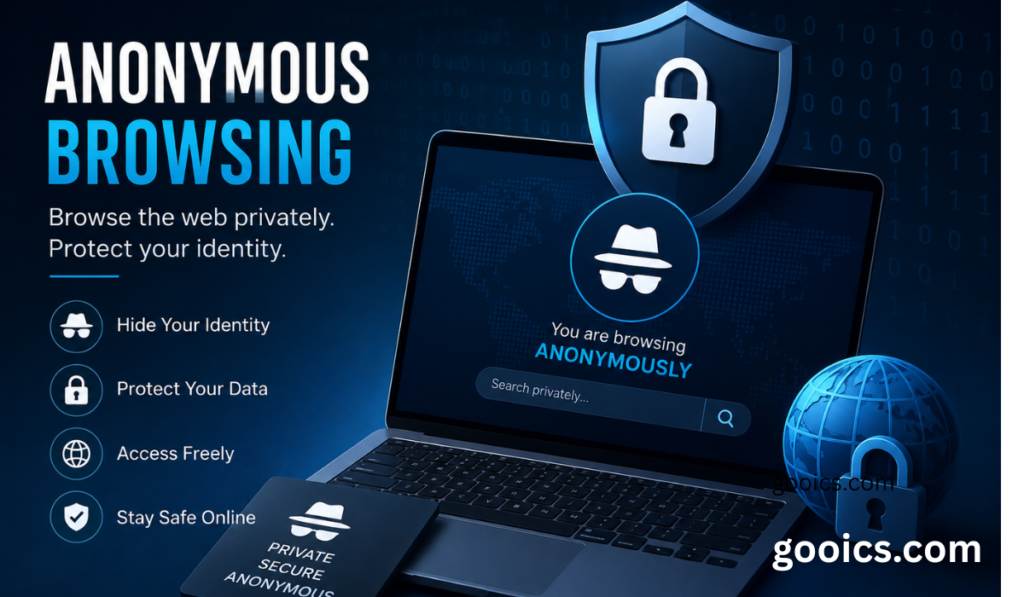

Every time you open a browser and visit a website, you leave a trail. Your IP address, device fingerprint, cookies, and browsing habits are quietly logged by internet service providers, advertisers, and the sites themselves. Anonymous browsing is the practice of minimizing or eliminating that trail — making it harder for anyone to tie your online activity back to you.
It’s a topic that matters to journalists protecting sources, everyday users tired of targeted ads, people living under restrictive internet censorship, and anyone who simply values privacy as a default rather than a luxury. This article breaks down what anonymous browsing actually achieves, the tools that claim to offer it, and the realistic limits of each.
What “Anonymous” Actually Means Online
True anonymity — leaving zero identifiable trace — is nearly impossible to achieve on the modern internet. What most tools and techniques offer instead is a meaningful reduction in traceability: hiding your IP address, blocking trackers, preventing your browser from being fingerprinted, or keeping your local device free of history.
It helps to separate anonymous browsing into three distinct goals, because no single tool solves all three:
- Hiding your identity from the websites you visit (they can’t tell it’s you)
- Hiding your activity from your network or ISP (they can’t see what sites you’re on)
- Hiding your activity from your own device (no local history, cookies, or cache)
Private browsing modes solve the third problem. VPNs and proxies solve the second. Tor and similar tools attempt all three, with tradeoffs.
Private Browsing Mode (Incognito)
Every major browser offers a private or incognito mode. It’s the most commonly misunderstood privacy tool available.
What it does: Prevents your browsing history, cookies, and site data from being saved locally after you close the window. Useful for shared or public computers, or for logging into a second account without conflicts.
What it doesn’t do: Hide your IP address from websites, prevent your ISP from seeing which sites you visit, or stop sophisticated tracking techniques like browser fingerprinting. Your employer, school network, or internet provider can still see your traffic.
Private mode is a good baseline habit, but it is not anonymous browsing in any meaningful sense against outside observers — only against someone using your device after you.
VPNs (Virtual Private Networks)
A VPN routes your internet traffic through an encrypted tunnel to a server operated by the VPN provider, masking your real IP address and encrypting your traffic from your ISP or local network.
Strengths:
- Hides your IP address and approximate location from websites
- Encrypts traffic so your ISP or a public Wi-Fi operator can’t see which sites you visit
- Useful for bypassing geographic content restrictions
Limitations:
- You’re shifting trust from your ISP to the VPN provider, which can usually still see your activity unless it has a verified no-logs policy
- Free VPNs often monetize user data — the opposite of what you’re seeking
- Doesn’t stop cookie-based tracking, account logins, or browser fingerprinting
A reputable, audited, paid VPN is a solid tool for network-level privacy, but it requires trusting the provider.
Tor (The Onion Router)
Tor routes your traffic through at least three volunteer-run relays worldwide, encrypting it in layers so no single relay knows both who you are and what you’re accessing.
Strengths:
- No single point (not even the entry or exit node alone) can link your identity to your destination
- Free and open-source, widely audited
- Effective against network surveillance and censorship
Limitations:
- Noticeably slower than normal browsing due to multi-hop routing
- Some websites block or challenge Tor exit node traffic
- Exit nodes can see unencrypted traffic (mitigated by using HTTPS sites)
- Using Tor can itself draw attention in some network environments, since the traffic pattern is recognizable
Tor is the strongest widely available option for genuine anonymity, particularly when paired with the dedicated Tor Browser, which also resists fingerprinting.
Proxies
A proxy server sits between you and the websites you visit, forwarding requests on your behalf and masking your IP address in the process.
Strengths: Simple, often free, and fast for basic IP masking.
Limitations: Most proxies don’t encrypt traffic, meaning your ISP or network administrator can still see the content of your activity, even if the destination site can’t see your real IP. Proxies are best thought of as a light-touch tool, not a privacy solution on their own.
Browser Fingerprinting: The Overlooked Threat
Even with your IP hidden, websites can often identify you through fingerprinting — combining details like your screen resolution, installed fonts, browser version, time zone, and hardware configuration into a unique signature. Studies have repeatedly shown that this combination is unique enough to identify most individual devices, even without cookies.
Privacy-focused browsers (such as Tor Browser or hardened configurations of Firefox) actively work to make users’ fingerprints look identical to one another, closing this gap. Standard browsers, even in private mode, generally do not.
Search Engines and Anonymous Browsing
Search engines that don’t log queries or build advertising profiles — often marketed as privacy-respecting alternatives to mainstream search — are a natural companion to anonymous browsing tools. Pairing a no-log search engine with a VPN or Tor closes off one of the most common tracking vectors: your search history itself.
Practical Recommendations
There’s no single “most anonymous” setup — the right combination depends on your threat model, meaning who you’re trying to stay private from:
- Casual privacy from advertisers: Private browsing + tracker-blocking browser extensions + a privacy-respecting search engine
- Privacy from your ISP or on public Wi-Fi: A reputable, audited VPN
- Strong anonymity from surveillance or censorship: Tor Browser, ideally combined with HTTPS-only browsing and caution around logging into personal accounts
- Maximum caution: Avoid logging into personal accounts, disable JavaScript where practical, and avoid mixing anonymous and identified sessions in the same browsing session
The Limits of Anonymous Browsing
It’s worth being honest about what these tools can’t do. Logging into a personal account — email, social media, banking — instantly reattaches your identity to that session, regardless of what tool you’re using underneath. Anonymity tools protect the pipe your data travels through; they can’t protect you from voluntarily identifying yourself at the other end.
Similarly, no tool protects against malware already on your device, physical surveillance, or legal processes that compel a service provider to hand over data it possesses. Anonymous browsing reduces exposure — it doesn’t guarantee invisibility.
Final Thoughts
Anonymous browsing isn’t a single switch you flip; it’s a set of layered choices that match the level of privacy you actually need. For most people, a combination of good browser hygiene, a trustworthy VPN, and awareness of what each tool can and can’t do will cover the vast majority of everyday privacy concerns. For higher-stakes situations, Tor remains the most robust option publicly available, provided you understand and accept its tradeoffs in speed and convenience.
Privacy online was never designed into the internet’s architecture — it’s something you have to actively build back in, one deliberate choice at a time.
Anonymous Browsing: Frequently Asked Questions
1. Does incognito or private browsing mode make me anonymous online? No. Private browsing only stops your browser from saving local history, cookies, and cache. Your ISP, network administrator, and the websites you visit can still see your IP address and activity.
2. Is a VPN enough for anonymous browsing? A VPN hides your IP address and encrypts your traffic from your ISP or local network, which covers a lot of common privacy concerns. However, the VPN provider itself can usually see your activity, so you’re trusting them instead of your ISP. It also doesn’t stop cookies, account logins, or browser fingerprinting from identifying you.
3. Is Tor completely anonymous? Tor is one of the strongest publicly available anonymity tools because no single relay can see both who you are and what you’re accessing. But it isn’t perfect — exit nodes can see unencrypted traffic, some sites block Tor, and logging into a personal account while using Tor immediately ties that session back to you.
4. Can websites track me even if I hide my IP address? Yes, through browser fingerprinting — combining details like screen resolution, fonts, time zone, and browser configuration into a signature unique enough to identify most devices, even without cookies or a visible IP address.
5. What’s the difference between a VPN and a proxy? A VPN encrypts all your traffic and routes it through a secure tunnel. A proxy typically only forwards your requests and masks your IP, without encrypting the underlying traffic — meaning your ISP can often still see what you’re doing.
6. Are free VPNs safe to use for privacy? Generally not recommended. Many free VPNs monetize users by logging and selling browsing data, which defeats the purpose of using one. A reputable, audited, paid VPN with a verified no-logs policy is a safer choice.
7. Does using a privacy-focused search engine help with anonymous browsing? Yes. Search engines that don’t log queries or build advertising profiles close off one of the most revealing tracking vectors — your search history — and work well alongside a VPN or Tor.
8. Can I be tracked even if I use Tor or a VPN and log into my email or social media? Yes. Logging into any personal account instantly reattaches your real identity to that browsing session, regardless of the anonymity tool running underneath it.
9. Does anonymous browsing protect me from malware or hacking? No. Anonymity tools protect the privacy of your connection and identity — they don’t defend against malware already on your device, phishing, or other security threats. Anonymity and security are related but separate concerns.
10. What’s the best setup for anonymous browsing? It depends on your threat model:
- Casual privacy from advertisers → private browsing + tracker blockers + a privacy-respecting search engine
- Privacy from your ISP or public Wi-Fi → a reputable, audited VPN
- Strong anonymity from surveillance or censorship → Tor Browser, used carefully and without logging into personal accounts
11. Can my employer or school still see what I browse if I use a VPN? On a network they control, they may still see that you’re connected to a VPN, and depending on their monitoring tools, potentially more. A VPN reduces visibility into specific sites and content, but it isn’t a guarantee against monitoring on networks you don’t control.
12. Is anonymous browsing illegal? No. Using VPNs, Tor, or privacy tools is legal in most countries, though a small number of countries restrict or ban them. Anonymous browsing is a privacy practice, not an inherently illicit one — what you do with it is what determines legality.