
Introduction
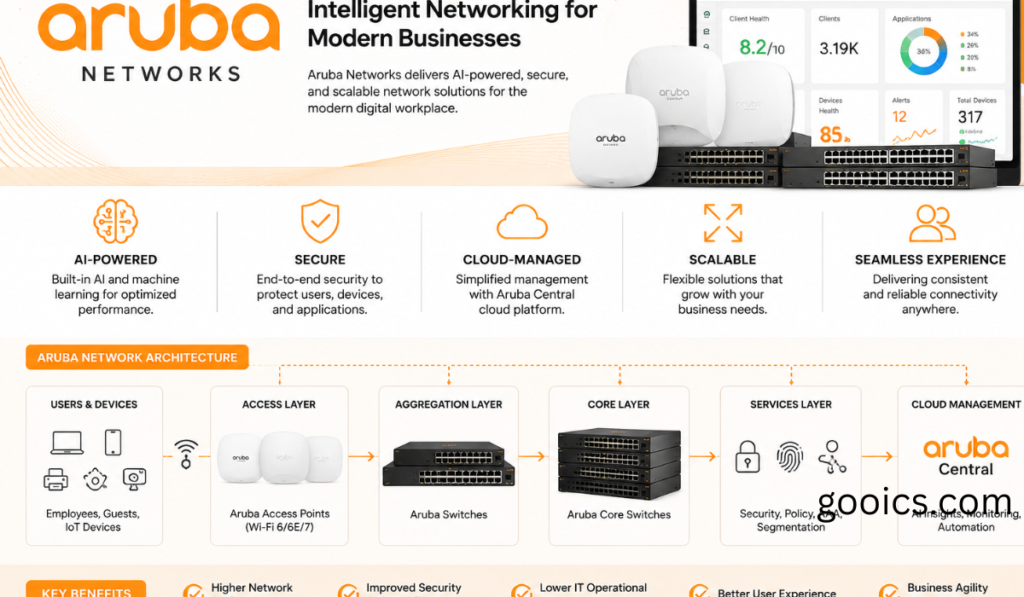
Every office, campus, retail store, and data center depends on a network running quietly in the background — and for a huge number of organizations, that network runs on Aruba. Now operating as HPE Aruba Networking following its integration into Hewlett Packard Enterprise, Aruba has grown from a wireless-networking specialist into a full portfolio covering switching, Wi-Fi, SD-WAN, and AI-driven network management. This article breaks down what Aruba Networking actually is, its core product areas, and why it continues to be one of the most recognized names in enterprise networking.
What Is Aruba Networking?
Aruba Networking, now branded HPE Aruba Networking, is an enterprise networking division that designs switches, wireless access points, and network management software for organizations ranging from small retail locations to large corporate campuses and data centers. It’s best known for wireless networking, but its portfolio has expanded significantly to include wired switching, secure access (SASE), and increasingly, AI-driven network automation.
Core Product Areas
Aruba’s offerings generally fall into a few core categories:
- Switching – Wired network switches, including the CX product line, used to connect devices like computers, point-of-sale systems, cameras, and IoT devices to the network.
- Wireless (Wi-Fi) – Access points and controllers supporting current Wi-Fi standards, including Wi-Fi 7, for reliable wireless coverage across offices, campuses, and public venues.
- SD-WAN and secure connectivity – Software-defined networking tools that manage traffic across multiple locations, along with unified SASE (secure access service edge) and next-generation firewall capabilities.
- Network management software – Centralized platforms, most notably Aruba Central, used to configure, monitor, and troubleshoot an organization’s entire network from one interface.
- AI-native network operations – Tools like the Marvis virtual network assistant, which uses AI to detect issues, recommend fixes, and increasingly resolve certain problems automatically.
Aruba Central: The Management Hub
Aruba Central functions as the unified control center for an organization’s network, covering switching, Wi-Fi, SD-WAN, and security from a single, cloud-based interface. It’s built on a microservices architecture, supports flexible deployment options, and is designed to bring together what used to be separate “day 0, day 1, and day 2” network operations — meaning initial setup, ongoing configuration, and continuous monitoring — into one system. According to HPE, this approach can shrink deployment timelines from weeks down to hours while reducing the volume of network trouble tickets an IT team has to handle manually.
The Shift Toward AI-Driven, Self-Driving Networks
A major theme in Aruba’s recent direction has been what HPE calls a “self-driving” network — infrastructure that doesn’t just report problems but actively diagnoses and resolves them using AI. Following HPE’s acquisition of Juniper Networks, the company has worked to blend Aruba’s switching and management tools with Juniper’s Mist AIOps and Marvis AI assistant technology, extending AI-driven insights and automated actions across wired, wireless, and SD-WAN environments, all managed through Aruba Central. The stated goal is a network that can predict issues before they cause outages and automatically apply fixes rather than simply alerting an administrator.
Where Aruba Fits in Specific Industries
Aruba’s product development often responds directly to industry-specific needs. In retail, for example, HPE has introduced compact, fanless switch models specifically designed for space- and noise-sensitive environments like checkout lanes, digital signage, and kiosks, paired with Power over Ethernet support for point-of-sale systems and cameras. This reflects a broader pattern in Aruba’s roadmap: rather than treating all customers the same, hardware and software updates are frequently tailored to particular deployment environments, from retail floors to large enterprise data centers supporting AI workloads.
Industry Recognition
HPE (Aruba’s parent company) has been positioned by Gartner as a leader in its Magic Quadrant for Enterprise Wired and Wireless LAN Infrastructure for multiple consecutive years, reflecting sustained strength in both product vision and execution within the networking industry. It’s worth noting that analyst recognition like this reflects one firm’s evaluation methodology and shouldn’t be treated as a guarantee of the best fit for every organization’s specific needs.
What to Consider Before Choosing Aruba
If you’re evaluating Aruba Networking for your organization, a few practical questions are worth asking:
- Do you need unified management across wired, wireless, and SD-WAN? Aruba Central’s biggest strength is bringing these together into one platform, which matters most for organizations managing multiple locations.
- How important is AI-driven automation to your IT team’s workload? Organizations with limited IT staff, such as retailers managing stores remotely, may benefit significantly from self-driving network features that reduce manual troubleshooting.
- What’s your existing infrastructure? Since HPE is actively integrating Aruba and Juniper technologies, it’s worth understanding which specific products and management tools apply to your intended deployment.
- Does your use case have specialized hardware needs? Certain environments, like compact retail spaces or large-scale AI data centers, may benefit from Aruba’s more specialized product lines built for those specific conditions.
Conclusion
Aruba Networking has evolved from a wireless-focused vendor into a full enterprise networking platform, unifying switching, Wi-Fi, SD-WAN, and security under an increasingly AI-driven management approach through Aruba Central. As HPE continues blending Aruba’s technology with Juniper’s AI operations tools, the direction is clear: less time spent manually managing network infrastructure, and more of that work handled automatically — though as with any vendor, the right fit still depends on matching the specific product lineup to your organization’s scale, industry, and existing systems.
FAQs: Aruba Network
1. What is Aruba Networking? Aruba Networking, now branded HPE Aruba Networking, is an enterprise networking division that designs switches, wireless access points, and network management software for organizations of all sizes.
2. Is Aruba the same as HPE? Aruba is now part of Hewlett Packard Enterprise (HPE) and operates under the HPE Aruba Networking brand, following its earlier acquisition by HPE.
3. What is Aruba Central used for? Aruba Central is a cloud-based management platform that lets IT teams configure, monitor, and troubleshoot switching, Wi-Fi, SD-WAN, and security from a single unified interface.
4. What does “self-driving network” mean in Aruba’s products? It refers to AI-driven network operations, such as the Marvis virtual assistant, that can automatically detect issues and take corrective action rather than simply alerting an administrator.
5. Does Aruba only make Wi-Fi products? No, while Aruba is well known for wireless networking, its portfolio also includes wired switching, SD-WAN, secure access (SASE), and firewall technology.
6. How does Juniper Networks relate to Aruba? After HPE’s acquisition of Juniper Networks, the company has been integrating Juniper’s Mist AIOps and Marvis AI technology with Aruba’s switching and Aruba Central management platform.
7. Is Aruba suitable for small businesses, or only large enterprises? Aruba serves both — it offers specialized hardware, like compact switches for retail checkout lanes, alongside larger-scale solutions for enterprise campuses and data centers.
8. Has Aruba/HPE been recognized by industry analysts? Yes, HPE has been positioned as a leader in Gartner’s Magic Quadrant for Enterprise Wired and Wireless LAN Infrastructure for multiple consecutive years.
9. What industries commonly use Aruba networking products? Aruba products are used across many industries, with dedicated solutions for sectors like retail, where compact, fanless switches support point-of-sale systems, kiosks, and digital signage.
10. What should I consider before choosing Aruba for my organization? Consider whether you need unified management across wired, wireless, and SD-WAN, how much you’d benefit from AI-driven automation, and how Aruba’s product lineup fits your existing infrastructure and industry-specific needs.