
Choosing between Claude AI and ChatGPT is no longer a question of “which chatbot is more fun to talk to.” Both tools have matured into serious platforms for writing, coding, research, and agentic work — and the right pick depends heavily on what you’re trying to do. This guide breaks down how Claude AI and ChatGPT actually differ in mid-2026: models, pricing, strengths, and the use cases where each one pulls ahead.
The Companies Behind the Models
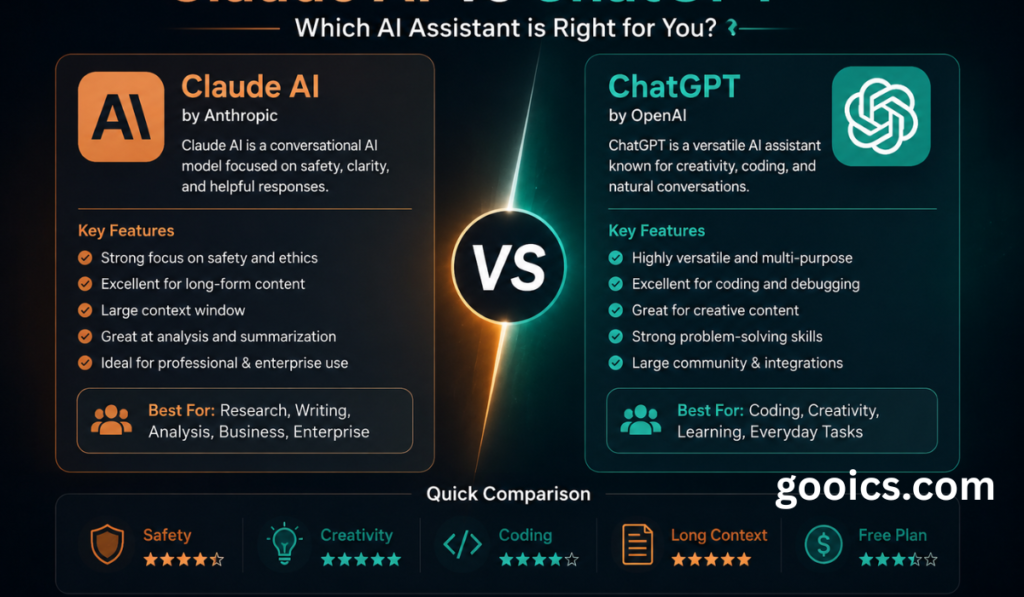
Claude is built by Anthropic, a company that has staked its identity on safety-focused AI development and a research approach called Constitutional AI. ChatGPT is built by OpenAI, the company that popularized consumer AI chat with the original ChatGPT launch and has since expanded into a much broader product ecosystem spanning chat, agents, image and video generation, and enterprise tools.
That difference in philosophy still shows up in how the two products feel to use. Claude tends to be more conservative and careful in its outputs, with a strong emphasis on long-context reasoning and careful writing. ChatGPT leans into breadth — more integrations, more media types, and a faster release cadence across a wider surface area.
Current Model Lineups
Claude’s lineup, as of mid-2026, runs across three tiers:
- Claude Haiku 4.5 – the fastest, most affordable model, built for high-volume or latency-sensitive tasks
- Claude Sonnet 5 – the current default model across Claude’s Free and Pro plans, optimized for agentic work like planning, coding, and tool use, with performance that closes much of the gap with Opus at a fraction of the cost
- Claude Opus 4.8 – the top-of-line model for the hardest, longest-horizon agentic and reasoning tasks, with a 1-million-token context window
- Claude Mythos 5 / Claude Fable 5 – Anthropic’s newest tier, sitting above Opus, aimed at frontier research and enterprise use cases
ChatGPT’s lineup has grown similarly layered. The current flagship family is GPT-5.6, split into three tiers — Sol (the highest-capability variant), Terra (a mid-tier balance of cost and quality), and Luna (the lightweight, budget option) — alongside GPT-5.5, which still serves as the fast, everyday default in many ChatGPT plans. OpenAI has moved toward this multi-tier, task-routed structure rather than shipping a single flagship model.
The practical takeaway: both companies now offer a “cheap and fast,” “balanced,” and “maximum capability” model at each layer, so the real comparison comes down to price-per-token, context window, and how each model performs on the tasks you care about — not just which one is “smarter” in the abstract.
Pricing Compared
Claude AI Plans
| Plan | Price | Best For |
|---|---|---|
| Free | $0 | Trying Claude out, light daily use |
| Pro | $20/month (~$17/month annual) | Most individual professionals |
| Max 5x / Max 20x | $100 or $200/month | Heavy daily users who hit Pro limits |
| Team | From ~$25/seat/month | Small teams needing shared workspace tools |
| Enterprise | Custom pricing | Large orgs needing SSO, compliance, SLAs |
Claude API pricing for developers: Sonnet 5 runs at an introductory $2 input / $10 output per million tokens through August 31, 2026 (standard pricing of $3/$15 afterward), while Opus 4.8 is priced at $5 input / $25 output per million tokens.
ChatGPT Plans
| Plan | Price | Best For |
|---|---|---|
| Free | $0 (with ads in some regions) | Casual, occasional use |
| Go | $8/month | Budget users who want more than Free |
| Plus | $20/month | Most individual users; unlocks GPT-5.6 Sol access |
| Pro | $100–$200/month | Power users needing 5x–20x higher limits |
| Business | ~$20–30/seat/month | Small-to-mid teams |
| Enterprise | Custom pricing | Large organizations |
On the API side, GPT-5.6 pricing is tiered: Sol at $5 input / $30 output per million tokens, Terra at $2.50/$15, and Luna at $1/$6.
At the entry-level subscription tier, the two products are priced almost identically — $20/month gets you the flagship experience on both. Where they diverge is at the API level, where OpenAI’s top-tier model output pricing runs noticeably higher than Claude’s, and in how usage limits are structured at the high end.
Where Claude AI Tends to Win
- Long-document work. Claude’s large context windows (up to 1 million tokens on Opus 4.8) make it well suited to digesting lengthy contracts, codebases, or research papers in a single pass.
- Writing quality and nuance. Many users find Claude’s prose feels more natural and less “AI-sounding,” with fewer generic phrasings and a stronger sense of tone.
- Agentic coding. Claude Sonnet 5 and Opus 4.8 are widely used inside developer tools like Claude Code, and Anthropic has invested heavily in making Claude reliable across long, multi-step coding sessions.
- Careful, cautious outputs. Because of Anthropic’s safety-first design philosophy, Claude is often the preferred choice for professional and enterprise settings where reliability matters more than flash.
Where ChatGPT Tends to Win
- Ecosystem breadth. ChatGPT integrates image generation (via Sora and DALL-E lineage tools), voice mode, custom GPTs, and a large plugin/app ecosystem that Claude doesn’t match feature-for-feature.
- Brand recognition and community. ChatGPT has a much larger user base, more third-party tutorials, and broader consumer awareness.
- Multimodal features. Advanced Voice Mode, Sora video generation, and deep research tools are more mature and widely rolled out across ChatGPT’s tiers.
- Flexibility across use cases. From casual brainstorming to entertainment to productivity, ChatGPT’s broad feature set makes it a strong generalist pick for people who want one tool for everything.
Head-to-Head Summary
| Category | Claude AI | ChatGPT |
|---|---|---|
| Best for coding/agents | Strong, especially long sessions | Strong, especially with Codex |
| Best for writing | Often preferred for tone and nuance | Very capable, more generic by default |
| Context window | Up to 1M tokens (Opus 4.8) | Varies by tier, generally smaller |
| Multimodal features | Growing, more limited | Extensive (image, video, voice) |
| Entry price | $20/month (Pro) | $20/month (Plus) |
| Free tier | Yes, usage-limited | Yes, usage-limited, ads in some regions |
| Enterprise focus | Safety and compliance-forward | Broad ecosystem and integrations |
So Which Should You Choose?
If your work centers on long documents, careful writing, or agentic coding tasks where reliability over many steps matters, Claude AI is likely to feel like the stronger fit. If you want one assistant that also handles image generation, voice conversations, and a wide range of consumer use cases, ChatGPT offers more breadth out of the box.
Many professionals end up using both — Claude for deep work and writing, ChatGPT for its wider feature set — since the $20/month entry price on each makes it inexpensive to try both and see which fits your workflow. Pricing, models, and features on both sides change frequently, so it’s worth checking claude.com/pricing and openai.com/chatgpt/pricing directly before committing to a plan.
FAQs: Claude AI vs ChatGPT
1. Which is better, Claude AI or ChatGPT?
Neither is “better” outright — it depends on the task. Claude tends to edge ahead on long-document analysis, nuanced writing, and extended coding sessions, while ChatGPT offers a broader feature set (image generation, voice mode, plugins) and wider general-purpose flexibility.
2. Is Claude AI free to use?
Yes. Claude has a Free plan with usage limits on the web, iOS, Android, and desktop. Paid tiers start at Pro ($20/month), with Max plans ($100–$200/month) for heavier usage.
3. Is ChatGPT free to use?
Yes. ChatGPT’s Free tier gives limited access to its models, with ads shown in some regions. Paid tiers start with Go ($8/month) and Plus ($20/month), scaling up to Pro ($100–$200/month).
4. What’s the difference between Claude Sonnet 5 and GPT-5.6?
Claude Sonnet 5 is Anthropic’s mid-tier, agent-focused model, priced around $2–3 input / $10–15 output per million tokens. GPT-5.6 is OpenAI’s current flagship family, split into Sol, Terra, and Luna tiers, with Sol priced at $5 input / $30 output per million tokens. Sonnet 5 is generally the cheaper option at comparable capability.
5. Which AI is better for coding?
Both are strong. Claude (especially Sonnet 5 and Opus 4.8, used heavily in Claude Code) is known for reliability across long, multi-step coding sessions. ChatGPT is also widely used for coding, particularly through OpenAI’s Codex tooling. Many developers use both and compare results on their specific codebase.
6. Which AI has a longer context window?
Claude generally leads here — Claude Opus 4.8 supports up to a 1-million-token context window by default, which is useful for analyzing long documents, contracts, or large codebases in one pass.
7. Does ChatGPT or Claude have better writing quality?
This is subjective, but many users find Claude’s prose reads as more natural and less formulaic, with fewer generic “AI-sounding” phrases. ChatGPT’s writing is also strong but can lean more templated by default depending on the prompt.
8. Can I use both Claude and ChatGPT together?
Yes, and many professionals do. Since both offer a $20/month entry-level plan, it’s inexpensive to run both side by side and route tasks — for example, Claude for deep writing or document work, ChatGPT for multimodal tasks like image or voice generation.
9. Which is better for businesses?
Claude is often favored in enterprise settings that prioritize safety, compliance, and predictable behavior, largely due to Anthropic’s Constitutional AI approach. ChatGPT’s Business and Enterprise tiers offer a broader integration ecosystem, which can suit companies wanting an all-in-one platform.
10. Do prices and models change often?
Yes — both companies update pricing and release new models frequently. It’s worth checking claude.com/pricing and openai.com/chatgpt/pricing directly for the latest numbers before subscribing.